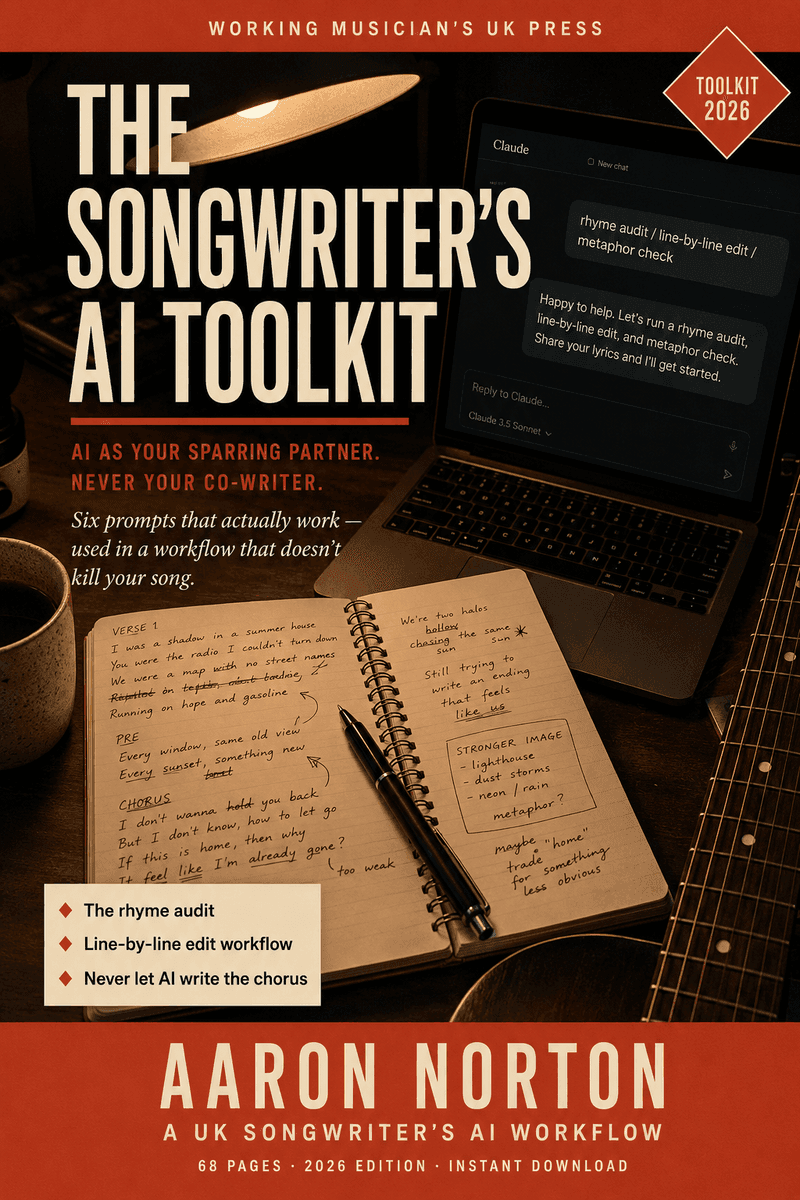

How to Use AI for Songwriting — as a Sparring Partner, Not a Ghostwriter
I'm a full-time acoustic musician, and I've stared at a blank page with a guitar on my knee more times than I can count. So when AI showed up, the obvious move was to hand it the song. And it works, technically — you type "write me a heartbreak song" and ChatGPT hands you a full lyric in ten seconds. Then you read it back and your stomach sinks, because it's fine. Smooth, rhyming, completely generic. A song about nobody, for nobody. If you can feel that, your listeners will too.
Here's the thing every "AI songwriting" guide gets wrong: they're all about making the AI write your lyrics. Type a prompt, get a chorus. This book — and this page — is about the opposite, and it's the only use that actually makes you a better writer: AI as the editor on the other side of the writing chair. It doesn't write your song. It reads your draft back at 1am, flags the line that's sagging, audits the rhyme you let slide, and hands you twenty images when you're stuck on one — and you keep every decision. The split is roughly 90% you, 10% AI, and the moment it inverts you stop being a songwriter and start being an editor of AI slop. The whole craft is keeping that line. (Tools and model versions move fast — anything dated below is an early-2026 snapshot; re-test before you commit.)
What AI can — and can't — do for a songwriter
Start with the bad news, because it sets up everything. AI cannot write the verse about your life. It doesn't know the smell of the pub where you met her, or the specific way your dad said your name when he was disappointed. Without that lived-in specificity, a lyric reads like a stock photo — nameless streets, nameless drinks, a chorus full of the weight of what we lost. You can spot AI lyrics from across the room. It can't write a hook with emotional truth, and it can't tell you which line moves you — that's your ear's job, and your ear only gets better by doing the work.
What it can do is the editorial spadework that used to need a co-writer, a workshop, or a year of feedback: audit your structure, catch your clichés, suggest contextual rhymes, run a thesaurus on an image, propose bridge directions when you're stuck, and write the boring admin (the lyric sheet, the blurb). It compresses that 10% from years into hours. The human supplies emotion, lived truth and choice; AI supplies options and speed. That division of labour is the whole book.
The one rule that changes everything: "do not rewrite"
Every model, left alone, will rewrite your verse by default — and most rewrites are worse than your original, because the model is optimising for smooth, not true. So the single most important instruction you'll ever give it is: "Identify the weaknesses. Do not rewrite. Do not propose fixes unless I ask." That one clause is the lock on the door. It turns the AI from an author back into an editor — it points at the problem and leaves the solving to you. Get that habit and everything else in this book works. Skip it and you'll generate clean, generic songs that aren't yours.
The six prompts that actually work
Most "AI songwriting" content is a hundred-prompt list for generating lyrics. You don't need a hundred prompts to critique a song — you need six, run until they're muscle memory. Before any of them, three setup rules: tell it the model (precise answers, not generic creative-writing), tell it the genre and tempo (a 90bpm acoustic ballad has different conventions to 140bpm garage), and tell it what NOT to do (the "do not rewrite" lock). Then the six, each one an audit, not a generator:
- The structural critique — where's the verse sagging, the chorus arriving late, the bridge repeating verse two's emotional work. The single most useful prompt in the book.
- The rhyme audit — every rhyme pair marked fresh / functional / cliché / forced.
- The metaphor density check — is the verse over- or under-metaphored.
- The imagery thesaurus — thirty alternative images for the one you're stuck on.
- The bridge generator — five bridge directions to react to (you take its question, not its bridge).
- The title brainstorm — a wide menu you choose from with your own ear.
The book gives you the exact wording, real before/after examples from my own songs, and the failure modes (what to do when the model rewrites anyway, or flags everything). This page gives you the shape; the book gives you the script.
Using AI to improve your lyrics (the line-by-line edit)
This is the cleanest, most honest use — and the one the generators can't touch, because it works on your writing, not theirs. Once your first draft is done (write that draft with the laptop shut — more on why below), you run the edit pass: a lazy-line detector (the line that's filler, not doing work), a show-don't-tell detector (where you stated the feeling instead of painting it), and a cliché flag (the thing AI generates worst, it detects best — ask it to mark every cliché and it'll catch the ones you'd stopped seeing). Each pass ends with a decision you make. The book has the full workflow and the printable checklist.
The rhyme audit — better than a rhyming dictionary
Searching for an "AI rhyme generator"? Reframe it. A rhyming dictionary has been a songwriter's tool since the 1990s, and AI is a better one — not because it spits out more rhymes, but because it's contextual: it gives you words that rhyme with forever AND fit the meaning, register and syllable count of your line. Better still, point it at your finished verse and ask it to audit every rhyme — fresh, functional, cliché, or forced — so you can decide which tired rhyme to keep (because the line earns it) and which to break. That's the editor move: not "give me rhymes," but "tell me which of mine are weak."
Stuck on the bridge? Ask for directions, not the bridge
The bridge is where songs stall. The trap is asking AI to write the bridge — you'll get a competent, generic eight bars that don't belong to your song. The move instead: feed it your two verses and two choruses and ask for five different bridge directions — a key change, a time shift, a perspective flip, a stripped-back drop, a lift. You don't take its bridge. You take its question — the reminder that the bridge has options you'd stopped seeing. Then you write yours.
Rescuing a stale chord progression
When a section feels too familiar, you don't need AI to write music — you need a menu of deviations to try with your own ear. The book's chord chapter lays out the real theory (the relative-minor swap is your first and best move; borrowed chords for a touch of another key; the deceptive cadence that promises home and goes somewhere else), and AI is good at laying that menu out on demand for your progression and key. You play each option and keep the one that makes the chorus actually lift. The theory is yours to learn; AI just speeds the trying.
Beating writer's block with constraint prompts
The counterintuitive truth: a blank page is too much freedom. The cure is a constraint — and AI is a tireless constraint machine. "Write a verse where every line starts with a question." "Tell the story backwards." "No adjectives." The constraint forces a way in, and once you're moving you drop the scaffold. But there's a wrong move first: don't ask AI to break the block by writing for you. Ask it for the exercise, then do the exercise yourself. The book has a chapter of these.
Best AI for songwriting: Claude vs ChatGPT vs Gemini
Every "best AI for songwriting" roundup ranks generators. For the job this book teaches — editing your own writing — here's the honest read from testing all three across the six prompts on my own songs (early 2026):
- Claude is the best general-purpose lyric editor. It stays out of the rewrite chair, ranks weaknesses cleanly, and respects the "do not rewrite" clause better than the others — which is the whole game.
- ChatGPT produces the best raw material — the longest, most varied imagery lists and the strongest rhyme sense — when you want quantity over editorial judgement. It's also the one most likely to rewrite when you told it not to, so guard it.
- Gemini is competent everywhere, rarely best at anything.
For the typical writer, one subscription (around £17/month) is the editor at your elbow every time you open the laptop — and a flat fee beats credit-metered tools, because you edit in bursts of ten prompts, not one. (Model versions change every few months — the shape holds, but re-test before you commit.)
Is using AI to write songs cheating?
The honest answer turns on which job you give it. Using AI to edit — to audit your rhymes, flag your clichés, critique a structure you wrote — is no more cheating than using a rhyming dictionary or taking a song to a co-writer for notes. Using AI to write the lyric for you is a different thing: not illegal, not immoral, but a different job, and the song stops being yours. There's also a rights wrinkle — collecting societies generally won't register a fully-AI work (it needs human authorship), so the more of the writing that's genuinely you, the better your footing. (The full copyright/PRS/ASCAP picture is the Suno book's territory — this page stays on craft.) Disclose AI assistance honestly and keep the 90/10 split, and you're a songwriter using a tool, not a tool pretending to be a songwriter.
Where the song actually comes from
One last thing, because it's the philosophy the whole book hangs from: you get better at songwriting by writing badly, sitting with it, and developing the ear that catches the badness next time. If AI catches every weakness for you in five seconds, you never build that ear — you stay at the level where you needed it. So write the first draft with the laptop shut. The AI belongs in the editing phase, never the writing phase. The craft is yours to build (the book grounds it in the real teachers — Pattison, Murphy, Stolpe); AI just sharpens the blade you've already made. Then, when the song's written, the rest of the toolkit is ready: turn it into a demo with Suno, record it properly with The Recording Manual, and give it a music video.