
How to Build a Musician Website That Updates Itself (Without Renting a Template)
I'm a full-time acoustic musician, and for years I did the thing you're probably about to do: I searched "how to build a musician website," found a dozen guides, and every one ended with me staring at a builder asking for £20 a month — forever — before I'd played a note on it. So let me be straight up front, because most of these guides won't be: you don't need to pay a designer, you don't need £240 a year, and you definitely don't need the kind of site that's already out of date the week after you build it. The site I use updates itself — it pulls my gigs in automatically — and it costs me roughly £10 a year. This is the honest guide to building one like it. (Two honest caveats kept throughout: it's an investment, not "free" — a weekend of your time plus the £10 domain — and tool prices and menus move fast, so anything dated here is a mid-2026 snapshot.)
Why most musician websites die
This is the most important sentence on the page: most musician websites die because there's no reason to come back. Someone pays £180–£360 a year for a Bandzoogle/Wix/Squarespace template, gets one wave of family-and-friends visits, and then it goes stale. The "Live Dates" page still shows a gig from last spring. A promoter clicks through, sees a dead date, and assumes you're not gigging — which is worse than having no site at all.
The reason isn't laziness. It's that the site was built as a brochure — a thing with a job to do once — instead of an instrument you pick up regularly. The fix isn't "remember to update your website." Nobody remembers to update their website. The fix is to build one that updates itself from the things you're already doing: adding gigs to your calendar, taking photos at gigs, sending the Sunday newsletter. Build a site you don't have to remember.
The magic trick: a gig list that updates itself
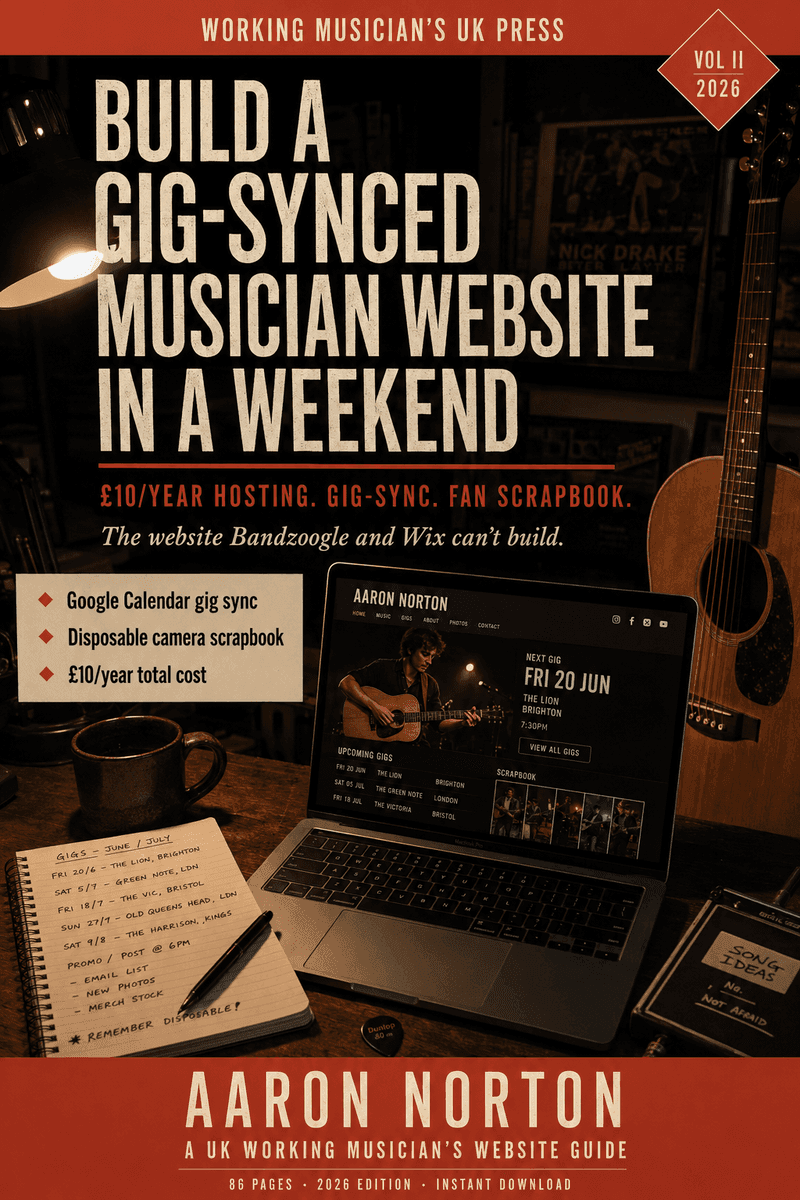
This is the feature that justifies the whole book. You add a gig to your Google Calendar on your phone; by the next morning, it's live on your website. You never touch the site. Add the booking once, in the one place you already keep your gigs, and the homepage's "next gigs" block is always current — a promoter glancing at it sees a packed, up-to-date calendar and instantly knows: this person works.
The obvious way to do this is to paste Google's embed code — and that's what every tutorial online tells you. Don't. An embedded Google Calendar is a clunky grey widget that looks nothing like your site and breaks when the quota runs out. The book teaches the better pattern: your site fetches the calendar once a day, saves it as a fast static file, and shows it as a gig list styled to look like your site — quick, reliable, and yours. The trade is that a gig added today appears tomorrow morning (plenty of lead time for a working musician). The full wiring is in the book; the concept is the thing to take away — the calendar is the source of truth, and the site reads from it.
(And here's where it compounds: that exact same gigs calendar is the spine of the auto-poster in The Automated Musician — one calendar entry feeds your website AND your social posts. Build the website's sync and you're most of the way to the whole engine.)
Can AI really build your website?
Yes — but be careful which kind of "AI website builder" you mean. The one-shot tools (the "describe it, get a site in 60 seconds" builders) are impressive demos, but they're optimised for a pretty one-shot result you then rent and can barely change. This book teaches the other path: you direct a conversational AI (Claude, ChatGPT or Gemini) to build a real site, in a real project, that you own and can edit for years. You don't write code — you describe what you want, paste the errors back when something breaks, and ask why until it works. The patience is the only real prerequisite; the skills come along the way. The difference matters: a one-shot builder gives you a site you're locked into; this gives you a site you understand and control. The book has the exact prompts; the mindset is "own it, don't rent it."
What it actually costs (~£10 vs £240 a year)
The honest economics no builder comparison shows you. A template builder is £141–£360 a year, every year (Wix ~£141, Bandzoogle ~£190, Squarespace ~£221 — 2026 pricing). The DIY path in this book is the £10 domain — because the hosting is free, the storage is free, and if you already pay for an AI tool for songwriting, admin or lyric help, the marginal cost of "and now I also have a website" is zero. The subscription's already on your card; the website is a side-effect. Two honest caveats: your weekend isn't free, and the free hosting tier (Vercel) has a non-commercial clause — for most musicians it's a non-issue, and if it ever bites, the paid tier is ~$20/mo, still less than Squarespace. The maths swings hard toward owning it.
Do you even need a website in 2026?
Honestly — only if it's an instrument, not a brochure. If you're going to build a dead three-page site that lists last year's tour dates, you're better off with a good link-in-bio. But a living site — one with a self-updating gig list, a fan scrapbook, your strongest track on autoplay — is the one door to your fanbase that no platform can lock, throttle, or delete. Instagram can change its algorithm tomorrow; your site is yours. The question isn't "do I need a website," it's "will I build one that's alive." If yes, it's the most durable asset you've got.
Your website IS your EPK
A contrarian one, and I'll back it with hard experience: don't build a separate EPK (electronic press kit) page. I've never used a dedicated EPK in my career and I get booking enquiries every single day — none of them off the back of an EPK. Your website already does everything an EPK tries to: it looks professional, the scrapbook is social proof no press quote can match, the live gig dates prove you're busy, and a clear /contact makes a booker's life easy. That's the entire EPK design brief, and a good homepage covers it in ten seconds. The one concession: some bookers will type "yourname EPK," so make /epk a one-line redirect to your homepage. Build the site well and the EPK builds itself.
What's wrong with the template you're paying for
Nothing, exactly — Bandzoogle, Wix and Squarespace are genuinely good products, and if yours is working, don't switch. The honest critique is narrower: templates are built for setup, not for return visits. They make it easy to open the box and hard to answer the only question that matters — will anyone come back next month? They also lock your time inside the template (every hour tuning a theme is an hour you can't transfer), and the casual visitor's eye is now trained to spot a stock template. Owning your own site costs more hours up front and compounds forever after.
You don't need a shop — outsource the checkout
A practical one that saves you weeks: don't build a store on your site. Selling music or merch means payment processing, tax, fraud, delivery — a whole maintenance burden. Link out to Bandcamp, Etsy or Gumroad instead, where the checkout, the tax and the delivery are someone else's problem, and put a strong Bandcamp embed on your /music page so a visitor can press play immediately. Your site's job is to send a warm fan to a place that already handles selling well. Simpler, safer, and it works.