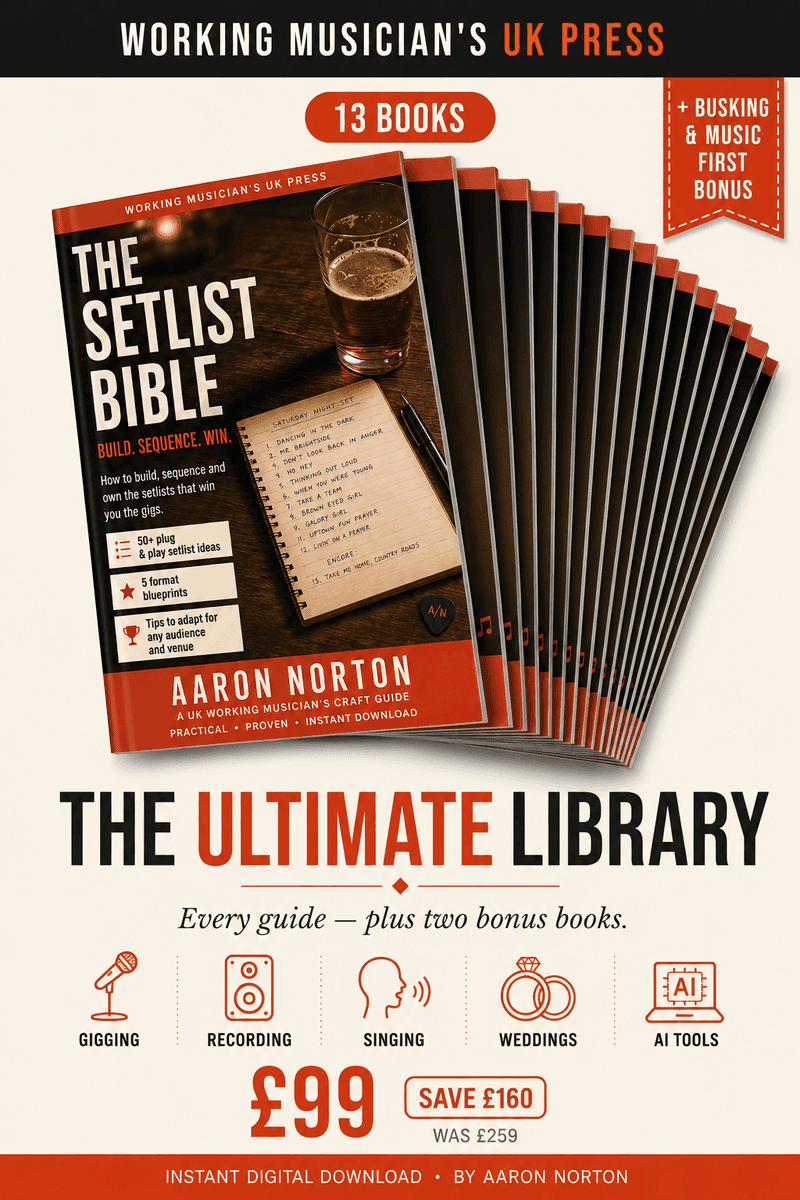
The Independent Musician's Library · 15 books
The Ultimate Library
Everything I know about making a living from music, in one library. All thirteen guides — the craft of gigging, running your own live sound, and the AI tools that buy back your time — plus two bonus books: How to Busk in the UK 2026, and Music First. Over 900 pages.

By Aaron Norton — independent solo artist, gigging since 2006.
I spent twenty years figuring this out the hard way — crouched behind mixers hoping they wouldn't feed back, emailing pubs that never replied, learning to record in a spare room, then learning to use AI without losing the song. Everything I wish someone had handed me on day one is in here.
Everything you get
- The 6 craft guides — gigs, weddings, recording, singing, setlists, reading a room£119.94
- The 5 AI guides — website, automation, Suno, music video, songwriting£99.95
- The 2 live-sound guides — The Vocal Chain + The Acoustic Chain£39.98
- BONUS · How to Busk in the UK 2026£10.79
- BONUS · Music First — the manifesto behind it allfree
£99 · instant download
Save £171 — 63% off — vs buying everything separately · UK VAT included · delivered as 4 zips + 2 PDFs
Buy now — instant download →Want more than one? Add them to your basket and pay in one go.
Secure checkout · instant PDF download · UK VAT included · also on Etsy
Every book is also sold on its own, and there are smaller AI, Craft and Live Sound bundles — but this is the whole library for less than half price.
All 15 books
- ◆The craft — The Setlist Bible · Read the Room · The Recording Manual · You Can Already Sing · The Wedding Musician's Playbook · How to Get Pub Gig Bookings.
- ◆The AI toolkit — Build a Gig-Synced Musician Website · The Automated Musician · Using Suno as Your Session Musician · Make a Music Video with AI · The Songwriter's AI Toolkit.
- ◆Live sound — The Vocal Chain · The Acoustic Chain — a feedback-free voice and a full, clear acoustic on the CQ12.
- ◆Bonus: How to Busk in the UK 2026 — pitches, permits and payments.
- ◆Bonus: Music First — the short manifesto behind the whole library.
The Latest Across the Library
Fresh picks from right across the library — AI, recording, live sound and the gigging craft — with my take and a link to the source.
Mr Brightside just lost a US number one it took 23 years to reach. It's still in the UK Top 100 this week.
Parade reports that Noah Kahan has knocked The Killers off the top of Billboard's Rock Streaming Songs chart, a spot Mr Brightside only got to in August after a 368-week run on it. Official Charts has it at 45 in the UK this week, 526 weeks in the Top 100 all told. I've been playing it in pubs for the best part of twenty years and it still does the same thing to a room every single time, which is worth remembering before you bump something off the set to make space for whatever came out last month.
Universal Audio's new Volt interfaces start at £120 and set your gain for you — the bit I'd actually pay for
I've said for years the interface is the last thing to overspend on, but a feature that stops you clipping a vocal take is a different matter. MusicRadar report that Universal Audio's new Volt Gen 2 and Volt Max range runs from £120 to £430, with every model above the entry-level Volt 1 getting Auto-Gain and Clip Protection, and the Max models adding six one-touch compressor presets drawn from UA's 1176 and LA-2A. If you record on your own in a garage like I do, nobody is watching the meter while you sing, so a box that sets the level and catches the peaks is worth more to me than another preamp flavour.
Gibson and Baggs have built a two-sensor acoustic pickup that keeps the signals apart until after the preamp
Guitar.com reports that Gibson and Baggs (LR Baggs, renamed for their 50th year) have launched HiFi DNA, a pickup system with two sensors that each get their own Class A preamp before anything is blended. Lloyd Baggs’s argument is that combining two sensors before amplification is what makes a plugged-in acoustic sound muddy, and he says it gives the same gain before feedback as their Element undersaddle, which is the claim I’d want to hear in a low-ceilinged pub before I believed it. It ships on Gibson acoustics for now, with a peel-and-stick standalone version promised, so the rest of us wait.
A small Dutch care-home study pitted singing against a chat, and neither clearly won
Dewi Boessen and colleagues report in the Journal of Alzheimer's disease : JAD that fifteen care-home residents with dementia did five weeks of group singing and five weeks of a conversation group that was identical apart from the music. The singing eased the load on the staff, while the conversation group came out ahead on a wellbeing scale, and in the room both held people's attention and lifted their mood about equally. That matches what I see at the day centre, where a lot of the good happens in the chat between the songs, and the authors are clear it was fifteen people and needs a bigger study before anyone reads too much into it.
Kling 4.0 is on the way in October, with 30-second clips, but there's no price yet so hold off on the annual plan
GPTunneL reports that Kuaishou announced Kling 4.0 at the end of September, with the full version due in October and a lighter Flash version in closed beta for annual subscribers only. The headline for a music video is length: up to 30 seconds in one go, double what Kling 3.0 does, plus up to 10 keyframes, so you could get a whole verse out of a single generation instead of stitching together short clips. Kling hasn't said what it'll cost yet, so I wouldn't lock into a yearly subscription just to get the early version. I'd wait for the full release and the pricing, then decide.
Their first dance is almost never in the right key for your voice, so ask the couple before you move it
When a couple asks me to learn their first dance, the first thing I check isn't the chords, it's whether my voice actually sits where the record does, because the original key is almost never the right one for one guitar and one voice. If I'm straining at the chorus I drop it a step or two, and if the verses are coming out mumbled I lift it, with a capo doing most of the work. What I don't do is change it without telling them. Most couples won't notice, but a few have practised dancing to it or have a bridesmaid planning to sing along, so I ask first.
From the bookWales is making a 30% rates cut for pubs and small music venues permanent, and that makes it easier for a landlord to book live music
The Welsh Government says pubs, bars, licensed clubs and live music venues with a rateable value under £51,000 will get a permanent 30% cut to their business rates from April 2027, once the Senedd approves the regulations. The word that matters to me is permanent, because a landlord who knows what next year's bills look like is far more likely to put music in the diary than one waiting to hear whether the temporary relief gets renewed. If you've got Welsh pubs on your list, next spring is a good time to be in their inbox.
Suno says its new v6 model learned partly from what users made on it, and the labels have called that laundering
Music Business Worldwide reports that Suno has now said v6 was trained on licensed partner content plus "creations and preference signals" from its own users. It says that doesn't mean audio people uploaded, though it didn't say the same about the tracks people generated. Sony and Universal's new complaint in Boston argues that training on the output of an earlier model they say was infringing doesn't clean anything up. For me the practical bit is simpler: if you're making tracks on Suno, read the terms and assume what you make there is feeding the next model, not just sitting in your library.
Soundcraft's new Signature Plus analogue mixers put a one-knob compressor on every channel, from £675
Gearnews report that Soundcraft have refreshed their Signature mixers as Signature Plus, in 12, 16, 22 and 32-channel sizes, with Ghost preamps, a three-band EQ with a sweepable mid and a one-knob dbx compressor on every channel, from £675 for the 12. The compressor is the bit I'd look at, because on an analogue desk at that money it's usually the thing that isn't there, and compression is what stops your vocal vanishing when you back off the mic and jumping out when you lean in. You don't get the recall or the feedback help a digital desk gives you, so you're setting it by ear every night, but if you'd rather have knobs than menus, that's not a bad trade.
SubmitHub is blocking anything its detector reckons is 85% likely AI, and nobody's drawn the line for the writing yet
Music Ally's Stuart Dredge reports that SubmitHub is now blocking submissions its own detector flags as at least 85% likely to be AI, with founder Jason Grishkoff saying "we're blocking pure AI submissions" and putting the detector at 99.4% accurate according to a third party, a call he reckons costs about 10% of his revenue. What it doesn't pin down is where that leaves the rest of us, because the detector is listening to the recording rather than to how the song got written. Bouncing a lyric off a chatbot and then singing it yourself into your own mic is a different thing from a track that came out of a box, and it's worth being able to say which one you did.
Not ready to buy?
Grab Music First free, or join The Soundcheck — one short email a week from the road, plus new guides as they land.