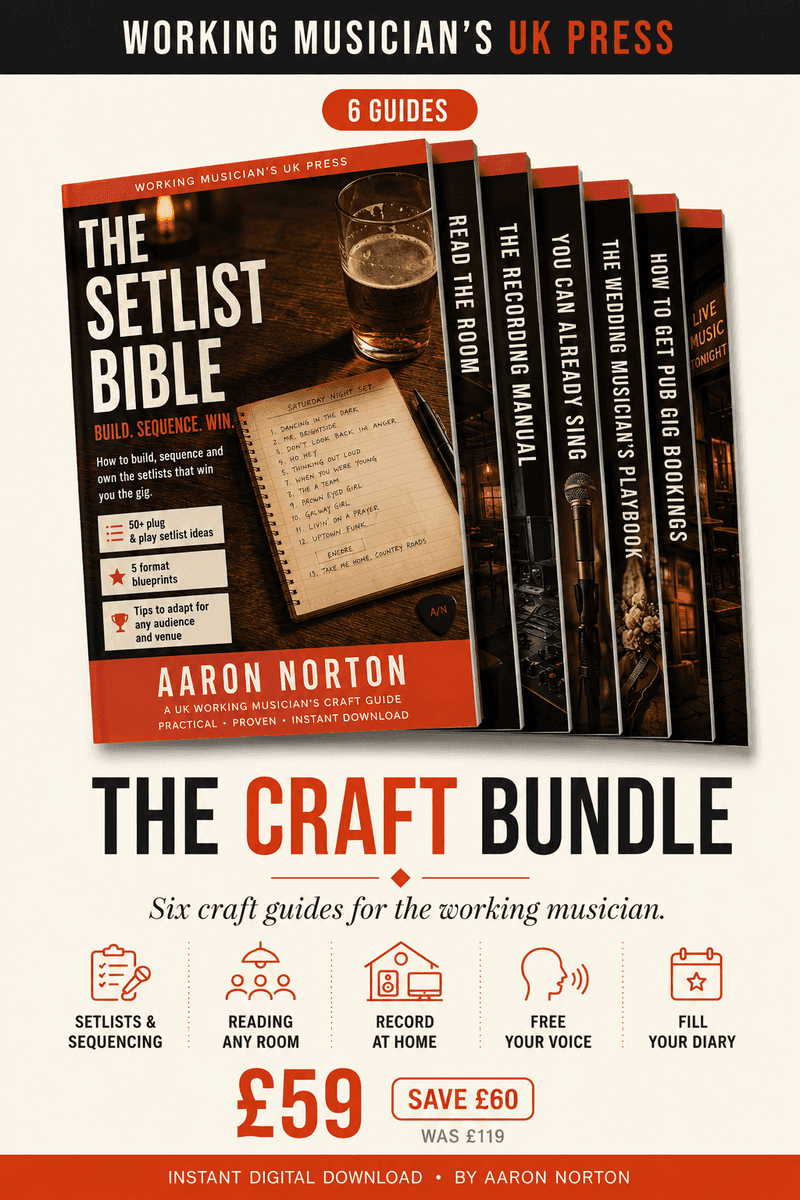
The Independent Musician's Library · 6 guides
The Craft Bundle
Six guides on the actual craft of making a living from live music — the things twenty years of gigging taught me the slow way. Building a set that wins a room, reading any crowd, recording your own releases, freeing your voice, playing weddings, and filling a diary.

By Aaron Norton — independent solo artist, gigging since 2006.
£59 · instant download
Save £60 vs buying the six separately · UK VAT included · delivered as 3 zip files
Want more than one? Add them to your basket and pay in one go.
Secure checkout · instant PDF download · UK VAT included · also on Etsy
Each of the six guides is also sold on its own — but this bundle is the best value.
What's inside
- ◆The Setlist Bible — build a set that reads a room and carries it.
- ◆Read the Room — the social intelligence of live performance, and how to get re-booked.
- ◆The Recording Manual — record, mix and master your own music at home, on any DAW.
- ◆You Can Already Sing — find the voice you already have.
- ◆The Wedding Musician's Playbook — book, price, prepare and play weddings.
- ◆How to Get Pub Gig Bookings — the outreach system that fills a diary.
The Latest for Working Musicians
Across the craft guides — recording, singing, setlists, reading a room, weddings and getting gigs, with my take and a link to the source.
Mr Brightside just lost a US number one it took 23 years to reach. It's still in the UK Top 100 this week.
Parade reports that Noah Kahan has knocked The Killers off the top of Billboard's Rock Streaming Songs chart, a spot Mr Brightside only got to in August after a 368-week run on it. Official Charts has it at 45 in the UK this week, 526 weeks in the Top 100 all told. I've been playing it in pubs for the best part of twenty years and it still does the same thing to a room every single time, which is worth remembering before you bump something off the set to make space for whatever came out last month.
Universal Audio's new Volt interfaces start at £120 and set your gain for you — the bit I'd actually pay for
I've said for years the interface is the last thing to overspend on, but a feature that stops you clipping a vocal take is a different matter. MusicRadar report that Universal Audio's new Volt Gen 2 and Volt Max range runs from £120 to £430, with every model above the entry-level Volt 1 getting Auto-Gain and Clip Protection, and the Max models adding six one-touch compressor presets drawn from UA's 1176 and LA-2A. If you record on your own in a garage like I do, nobody is watching the meter while you sing, so a box that sets the level and catches the peaks is worth more to me than another preamp flavour.
A small Dutch care-home study pitted singing against a chat, and neither clearly won
Dewi Boessen and colleagues report in the Journal of Alzheimer's disease : JAD that fifteen care-home residents with dementia did five weeks of group singing and five weeks of a conversation group that was identical apart from the music. The singing eased the load on the staff, while the conversation group came out ahead on a wellbeing scale, and in the room both held people's attention and lifted their mood about equally. That matches what I see at the day centre, where a lot of the good happens in the chat between the songs, and the authors are clear it was fifteen people and needs a bigger study before anyone reads too much into it.
Their first dance is almost never in the right key for your voice, so ask the couple before you move it
When a couple asks me to learn their first dance, the first thing I check isn't the chords, it's whether my voice actually sits where the record does, because the original key is almost never the right one for one guitar and one voice. If I'm straining at the chorus I drop it a step or two, and if the verses are coming out mumbled I lift it, with a capo doing most of the work. What I don't do is change it without telling them. Most couples won't notice, but a few have practised dancing to it or have a bridesmaid planning to sing along, so I ask first.
From the bookWales is making a 30% rates cut for pubs and small music venues permanent, and that makes it easier for a landlord to book live music
The Welsh Government says pubs, bars, licensed clubs and live music venues with a rateable value under £51,000 will get a permanent 30% cut to their business rates from April 2027, once the Senedd approves the regulations. The word that matters to me is permanent, because a landlord who knows what next year's bills look like is far more likely to put music in the diary than one waiting to hear whether the temporary relief gets renewed. If you've got Welsh pubs on your list, next spring is a good time to be in their inbox.
Four people in the room for the first hour isn't a dead hour. Some of my residency regulars started out as that four.
Plenty of pub gigs start before the crowd does, and you can find yourself playing to four people for the first hour. I treat that hour as a warm-up in front of an audience, because those four are the ones actually listening, they'll talk to you between songs, and they're the ones who tell their friends arriving later that you're worth sticking around for. I've had pub gigs where that first-hour audience became the loyal core that came back every month for the residency.
From the bookEveryone asks the couple what they want played. The question that actually saves you is what they don't.
Picture a drinks reception where a friend of the bride asks for a song, you play it happily, and across the room the bride's face falls because that was her first dance and you've just spent it. It's never happened to me, and the only reason is that I ask both questions before the gig — what do you want, and what do you absolutely not want, or not until later in the day. It might be a first dance you mustn't pre-empt, or a song that reminds someone of a person they've lost, and you'll never guess any of it.
From the bookStroke survivors who can't get the words out can often still sing them
Alison Talmage, a music therapy researcher at the University of Auckland, wrote in The Conversation about the choir her centre has run for nearly twenty years for people living with stroke, Parkinson's and dementia. She reports that stroke survivors with aphasia can often sing a favourite song more fluently than they can speak it, and that people with Parkinson's who struggle to project their voice find singing helps them speak more loudly and clearly. That second one is what stuck with me, because breath and support are the same things I go on about with anyone who wants to learn to sing, and it turns out they're also what gets somebody heard again.
Lewitt have made their headphone-calibration plugin free — worth a look if you mix on cans like I do
Most of my recording gets done on headphones, because the room isn't treated and the garage is never quite quiet enough, and headphones are exactly where a mix will lie to you. Sound On Sound report that Lewitt have released Space Replicator Free, a cut-down version of their virtual mixing room that emulates monitoring in a treated studio and carries calibration profiles for over 800 headphone models, running as VST3, AU or AAX with no iLok and no internet connection required. The free version gives you one room and a smaller set of reference systems rather than the full paid set, but it costs nothing to put against a mix you already know inside out.
Bridebook puts UK ceremony music at £845 and reception music at £1,061, and 41% of receptions are under 60 guests
Bridebook's UK Wedding Report 2026 is built on around 7,000 couples, and Zoe Burke's breakdown puts the average wedding at £20,604 with ceremony music at £845, reception music at £1,061 and other entertainment at £844, which together come to 7% of the budget. What caught my eye more than the money was the size of the room, because they reckon the average ceremony has about 74 guests and 41% of receptions are under 60. That's not a room crying out for a six-piece, and if you're quoting for weddings it's worth knowing the ceremony and the evening are two separate pots of money.
Not ready to buy?
Grab Music First free, or join The Soundcheck — one short email a week from the road, plus new guides as they land.