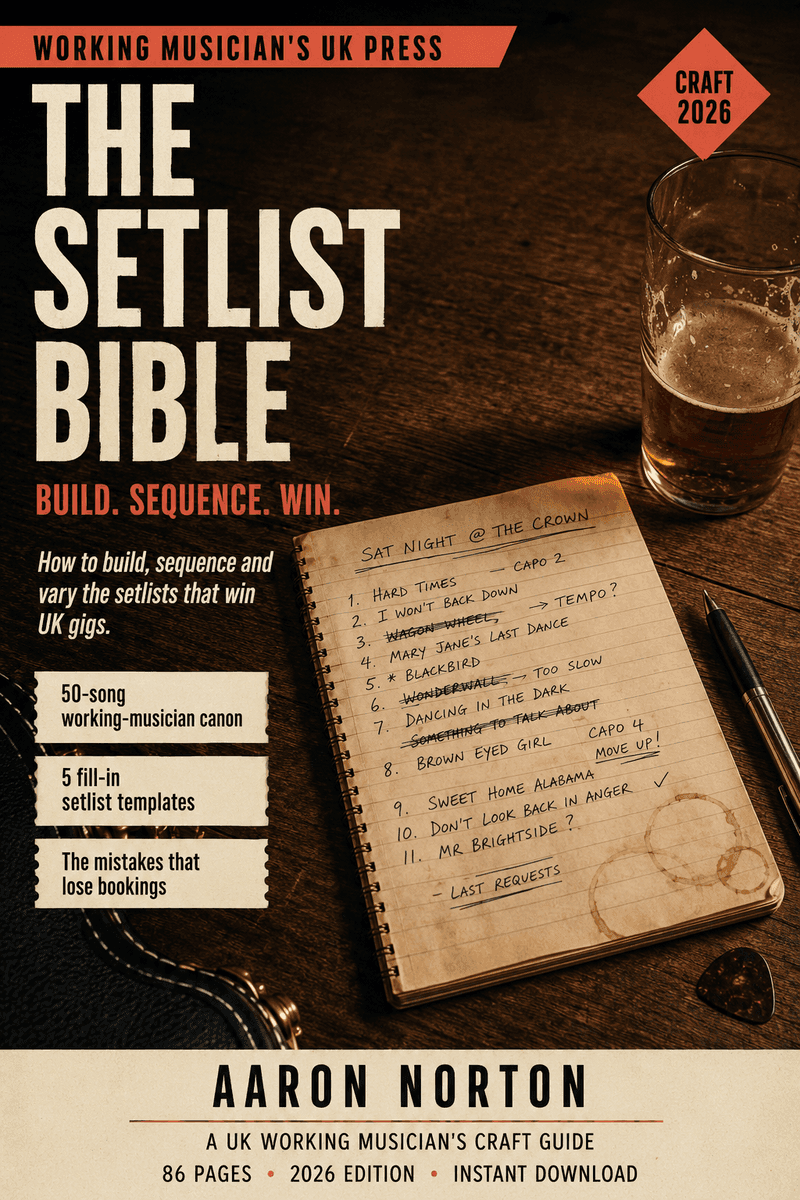

How to Build a Setlist That Wins the Room — Song Order, Energy and the Reorder That Gets You Re-Booked
I'm a full-time acoustic musician, and for years I made the same mistake nearly everyone makes: I printed one setlist on a Sunday afternoon, stuck a bit of tape on the back of the guitar, and played that exact running order at every gig for months. Then I'd walk into a wedding with my pub set, watch the bride's mum stare at the floor by song six, and not understand why the same songs that killed on Friday were dying on Saturday. The songs hadn't changed. The room had — and my setlist didn't move with it.
Here's the thing most "how to make a setlist" advice gets wrong: it treats the setlist as the list of songs you're going to play. It isn't. The list is the input. The setlist is what you build with that list — a shape, for this room, tonight, that you're allowed to change as the night goes on. Same musician, same songs, different order = a completely different night, and often the difference between a one-off and a re-booking. This book is twenty years of building, breaking and rebuilding setlists across pubs, weddings, function gigs, corporates and parties, distilled into a system you can apply to your own gig diary. This page is the honest overview of how that system works.
What a setlist actually does (it's three jobs, not one)
A setlist isn't a playlist with a start time. It does three jobs at once, all night:
- It controls the energy curve. Energy in a room is a tide — it comes in, peaks, goes back out. Your job is to shape that tide on purpose instead of letting it happen to you. The classic mistake is burning your best song third, out of nerves, on a half-empty room that isn't ready for it.
- It tells the room who you are in the first three songs. People sort themselves fast. Your opening songs announce whether you're a covers act with originals in the back pocket or a singer-songwriter with covers tucked in — and the room decides whether to listen, sing along, or drift. Trying to be everything to everybody reads as "this person doesn't know what they are."
- It's built with enough slack that you can read the room as you play. This is the one nobody writes about. A great setlist isn't a plan you follow to the letter — it's a plan you can deviate from intelligently the moment the room tells you to. That means having interchangeable songs, a reserve list, and knowing which song is safe to cut if you're running long.
The book breaks each job down with the real examples. The short version: if you've only got exactly enough songs to fill the time and you march through them in order, you don't have a setlist — you've got a list you're reading off. The moment it becomes a setlist is the moment you can look up three songs in, clock what the room wants, and lean that way.
The energy arc: warm, lift, peak, land, close
Every set, whatever its length, climbs the same five-act shape — and this is the single most useful thing to hold in your head when you build one:
- Warm — the opening. A familiar, mid-tempo song everyone knows. Not your best song, not your hardest. Something that says "we're here, you're here, this is happening."
- Lift — the early middle. Up in tempo, up in singability. Heads start turning.
- Peak — the heart of the set. Your strongest material, the big sing-alongs, the two songs you'd play if you only had ten minutes. This is where your best song goes — never the warm-up.
- Land — the back stretch. Slower, more emotional, a song they can put a drink down for. The peak isn't the end; the landing matters too.
- Closer — the walk-off. All the energy of the peak but with a definite ending — a clean stop, never a fade-out.
Think of it as five segments, not five song-numbers, because how many songs land in each depends entirely on how long you're playing and what room you're in. A fifteen-song pub set and a seven-song support slot climb the exact same arc — they just spread it over a different number of songs. And the gradient bends to the venue: a pub climbs hard all night, a wedding dinner barely lifts off the floor, a care home sits warm and steady the whole way through. The book draws each shape as a graph you drop your own songs into.
The commonest failure isn't picking the wrong songs — it's drawing no curve at all: piling every up-tempo song at the front so the back half is a string of slow ones, or playing the banger too early and dying on the comedown.
What song should I open with? (and what to close on)
Two of the most-searched setlist questions, and the answers are counter-intuitive:
The opener is not your best song. It's a familiar, medium-energy song that announces who you are without demanding the room commit before they're ready. You can't open with Mr Brightside or Don't Look Back in Anger to announce yourself — those are peak songs, and their place isn't the start. The opener's job is to settle the room and start the climb. (At a festival or support slot the rule inverts — there's no warm-up, so song one has to land like song eight of a pub set. Different animal, covered in the book.)
The closer must end on something, not into nothing. A song that fades out on a held final note gets a polite clap and an immediate turn to the bar. A closer ends on a clean, definite stop so you can say thank you and put the guitar down with the room still warm. And here's the bit that catches people: the last song before a break should leave them wanting more — which means it shouldn't be your biggest song either. Spend your single biggest song walking into a break and the back half has nowhere left to climb.
How many songs in a 45 or 60-minute set?
The question everyone Googles before their first proper booking, and the honest answer depends on your songs and how much you talk between them — but here are the working numbers I build to. A 60-minute set is roughly fifteen songs (a touch fewer if there's chat or a guitar lesson going on between them). A 45-minute set — the standard shorter weekday booking — is around twelve to thirteen. My standard booking is 2 × 60: two sixty-minute sets with a break, about two hours of singing across the whole night.
That two-hour figure isn't a physical limit — it's a line I draw on purpose to protect the voice, especially on days I'm playing two gigs. The book lays out the full set-length model (the weekday 2 × 45, the occasional three-hour afternoon slot that's still only ~two hours of actual singing with breaks built in, the rare all-day 4 × 30) — but the headline holds: build your craft around the one-hour set, because it's the best unit there is, and the longer and more spread-out the sets, the more people you lose in the gaps.
A list and a setlist are not the same thing
This is the idea the whole book hangs from. Your list is everything — every song you can play cold, the ones you love and the ones you learned because they work for your rooms. It runs to far more than you'd play in a night; mine sits north of a thousand songs. It's a library, not a plan.
Your setlist is a filtered version of that list, shaped for the room in front of you — and allowed to change on the night. Which is exactly why I don't turn up with precisely enough songs for the gig. I turn up with at least double — near enough two different sets in my back pocket — so I can pull the night either way depending on what the room gives me. That slack, the gap between the whole list and what you actually play tonight, is the setlist doing its job. A list can't read a room. A setlist can.
Don't stack the same flavour: the genre and decade spread
Two simple rules keep a room's attention from drifting. Try not to put two songs of the same sub-style back to back — a country song into another country song tells the room "we're a country act" even when you're not, and two folky ballads in a row make the back half feel like one long song. Mix it: country, then 90s indie, then soul. (The one exception: deep inside the peak, when the room's fully with you, you can run two of the same flavour if they're both bangers.)
And spread the decades — it's one of the easiest ways to pull a wider crowd, because every age bracket hears something from their own years and feels catered for. Don't think in ten-year decades, though; a room feels it in roughly four broad eras (50s–60s, 70s–80s, 90s–00s, and modern). Ignore the charts online that tell you a set should be "20% 2010s, 15% 1990s" — those percentages are made up, because every audience is different. What actually sets the weighting is reading the room and, above everything, familiarity — people light up at what they already know, and familiarity beats currency nearly every time. The book has the era dial and the exact familiarity ratios per venue.
Key and tempo: where I part company with most setlist advice
You'll read that you should plan the keys of your set like one long suite — that a song in G into a song in F♯ "feels like a stumble," that you should move in fourths and fifths. Honestly? I've gigged twenty years and never once thought about the key of one song relative to the next, and neither does the audience. What key a song is in makes no difference to a room — what matters is the energy you put in and whether they know it.
Where key does matter is to you and your voice, in the room you're in. Capo up to take a song higher when it needs more power (perfect in a lounge, or when someone's actually listening to a request); drop it a tone for a gentler room or a tired voice. The only key mistake that actually costs you is singing a song in a key your voice can't carry in that room — too high and you strain, too low and it comes out gutless. Tempo, on the other hand, genuinely does flow song to song: don't sit on the same tempo for three songs running, use a clear tempo jump to change gear between segments of the arc, and never drop two slow songs in a row early unless the night's genuinely a mellow one.
How to pace your voice so it lasts the whole gig (and the whole week)
This is the principle that separates working musicians from amateurs, and it lives in the running order, not the warm-up. Songs sit in roughly four vocal registers — full-chest belt songs, comfortable mid-range, light falsetto, and near-spoken talk-singing. The rule of thumb I build to: for every belt song, give yourself around four easier songs before the next one. Two belts in a row early is fine. Two belts in a row at the 90-minute mark and you're hoarse for the back half. So your warm-up songs (one and two of set one) are mid-range, never belts — your voice needs three or four songs to settle before you push. The book has the spacing laid out and the full vocal-survival chapter (hydration, the cold room, the morning after a heavy run).
This matters more than it sounds. A busy week of five or six gigs is ten or twelve hours of singing — your voice won't pack in at the two-hour mark, but treat it carelessly across a week and it will. Pace it in the setlist and you can do this for twenty years.
Taking requests without getting caught out
You'll be asked for songs that aren't on your list — constantly, at weddings and parties. The setlist's job is to make "yes" possible. Two things do that. First, a request reserve: twenty or thirty songs you know stone cold, in a key you can sing, that aren't on tonight's list but you can pull out in a second. Second — and this is worth more than any list — when someone comes up, ask them for an artist, not a song. Ask "what do you want to hear?" and one obscure song you don't know leaves you saying no; ask "who do you like?" and a single artist hands you five or six options to pick from. And if you genuinely can't do it, never flat-out "no" — offer something close from the same artist. You keep the goodwill and the room sees you trying. (How to read and steer those moments live is the territory of Read the Room — more on that below.)
Reading the room is the override — and where the sister book comes in
Here's the honest truth that runs under everything: a setlist is the structure, and reading the room is the override. Both are needed. Three songs in, you'll know things you didn't when you wrote the list at the kitchen table — the crowd skews older, the wedding party are dancing during your dinner set, the pub's half-empty and huddled in a corner. The best nights I've ever had were ones where I walked in with no fixed list at all and built the whole set off the room and the requests. After enough years, that isn't being unprepared — it's about the most prepared you can be.
This is exactly where this book and its sister split cleanly. This book owns the how — building a list with enough slack that you can deviate without panicking. Read the Room owns the why — the social intelligence of steering a room while you play, the live psychology of energy, tempo and familiarity. They're designed to be read together; honestly, Read the Room sets you up nicely for this one. If you build weddings, the day-by-day phase detail (contracts, the speech timeline, full-day pricing) goes deeper in The Wedding Musician's Playbook, and if you need to find the pub and care-home gigs in the first place, that's How to Get Pub Gig Bookings. This book stays on one thing: the running order.
The setlist crimes that quietly lose you bookings
Most lost bookings aren't exotic — they're avoidable running-order errors. The big ones the book walks through: two slow songs in a row when the room wanted lifting (a crime only in the wrong room — fine for a mellow Sunday); the mid-evening voice-blower that leaves you croaking by the closer; the closer that fades out instead of landing; repeating a song across sets (the crowd remembers, and feels cheated); ignoring the demographic spread (your Saturday pub set at a 60th); and the big one at weddings and parties — not asking what not to play. Everyone asks "what do you want?" Almost nobody asks "what do you absolutely not want, and is anything off-limits until later?" — and that's how you spend the couple's first dance during the drinks reception because a mate requested it. Ask both questions, every time, and the crime never happens.