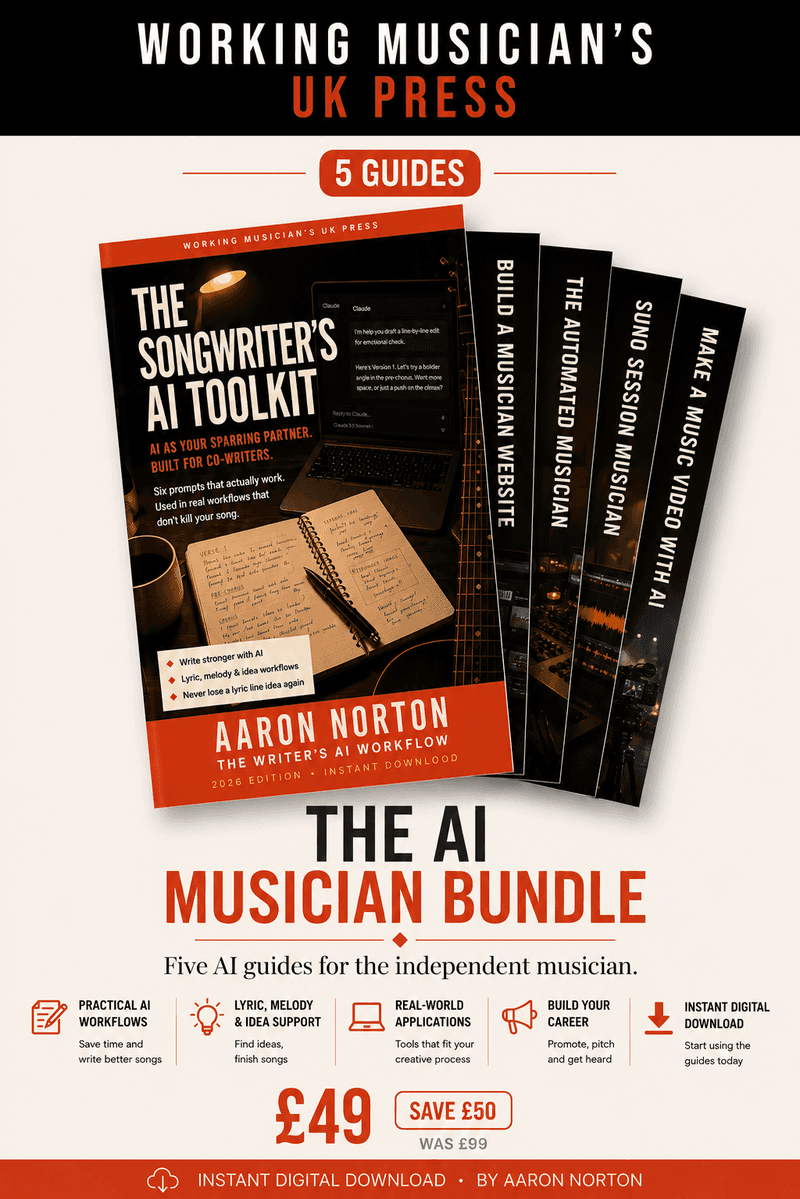
The Independent Musician's Library · 5 guides
The AI Musician Bundle
AI is changing everything — and as musicians that's our chance, not our threat. Let the machine take the boring half (the posting, the admin, the chasing) so you can pour more of yourself into the half that actually matters: the music. These five guides are exactly how I do that.

By Aaron Norton — independent solo artist running every one of these systems on his own music since 2006.
£49 · instant download
Save £50 vs buying the five separately · UK VAT included
Want more than one? Add them to your basket and pay in one go.
Secure checkout · instant PDF download · UK VAT included · also on Etsy
Each of the five guides is also sold on its own — but this bundle is the best value.
What's inside
- ◆Build a Gig-Synced Musician Website in a Weekend — a site that updates itself for about £10 a year.
- ◆The Automated Musician — hand the social media, newsletter and gig admin to a machine.
- ◆Using Suno as Your Session Musician — AI demos and arrangements without losing the song or the royalty.
- ◆Make a Music Video with AI — a four-minute, hyper-realistic video for £0 in generation cost.
- ◆The Songwriter's AI Toolkit — ChatGPT and Claude in the writing room, without letting them write the chorus.
The Latest in AI & Music
Across all five AI guides — what's moving in AI music, video, songwriting, promotion and the web, with my take and a link to the source.
Kling 4.0 is on the way in October, with 30-second clips, but there's no price yet so hold off on the annual plan
GPTunneL reports that Kuaishou announced Kling 4.0 at the end of September, with the full version due in October and a lighter Flash version in closed beta for annual subscribers only. The headline for a music video is length: up to 30 seconds in one go, double what Kling 3.0 does, plus up to 10 keyframes, so you could get a whole verse out of a single generation instead of stitching together short clips. Kling hasn't said what it'll cost yet, so I wouldn't lock into a yearly subscription just to get the early version. I'd wait for the full release and the pricing, then decide.
Suno says its new v6 model learned partly from what users made on it, and the labels have called that laundering
Music Business Worldwide reports that Suno has now said v6 was trained on licensed partner content plus "creations and preference signals" from its own users. It says that doesn't mean audio people uploaded, though it didn't say the same about the tracks people generated. Sony and Universal's new complaint in Boston argues that training on the output of an earlier model they say was infringing doesn't clean anything up. For me the practical bit is simpler: if you're making tracks on Suno, read the terms and assume what you make there is feeding the next model, not just sitting in your library.
SubmitHub is blocking anything its detector reckons is 85% likely AI, and nobody's drawn the line for the writing yet
Music Ally's Stuart Dredge reports that SubmitHub is now blocking submissions its own detector flags as at least 85% likely to be AI, with founder Jason Grishkoff saying "we're blocking pure AI submissions" and putting the detector at 99.4% accurate according to a third party, a call he reckons costs about 10% of his revenue. What it doesn't pin down is where that leaves the rest of us, because the detector is listening to the recording rather than to how the song got written. Bouncing a lyric off a chatbot and then singing it yourself into your own mic is a different thing from a track that came out of a box, and it's worth being able to say which one you did.
Ticketmaster is the first music connector in Meta's new AI assistant — and your pub gig isn't in that feed
Music Ally's Stuart Dredge reports that Ticketmaster is the first music partner for Muse, the personal AI agent Meta launched on 8 September: a fan can ask it what's on and get concerts, seating options and prices, then get popped out to Ticketmaster's site to actually buy, and Ticketmaster already plugs into Gemini, Claude, ChatGPT and Alexa as well. None of my Friday nights in a pub go anywhere near a ticketing platform, so none of that ever sees them. That's the reason the dates live on my own site, and why it's worth keeping them current and plainly written, because it's the only copy of them I control.
Threads now shows how much of each post's reach came from people who don't follow you yet
Social Media Today reports that Threads has updated its profile insights so you can see, post by post, how much of your reach came from followers and how much came from people who haven't followed you yet, along with an AI summary of what drove the results. I auto-post my gig announcements to Threads on gig mornings, and the question I actually want answered is whether any of that gets beyond the people who already come to the gigs. That split is the number worth checking, because a post that only reaches your followers is keeping people informed rather than finding you new ones.
The EU's AI content rules kicked in on 2 August — if your video is AI, you now have to say so
The European Commission's guidance says Article 50 of the AI Act applies from 2 August, so anyone publishing AI-generated video that could pass for real now has to disclose it clearly, at first view. The bit that matters for a music video is the carve-out: where the work is obviously artistic or fictional, the Commission says the disclosure only has to be made in a way that doesn't hamper the enjoyment of it — an end card or a line in the description, not a banner across the whole thing. I'm in the UK, but plenty of the people watching aren't, so I'd sooner label it than find out the hard way.
The Munich verdict landed — GEMA won, and Suno has been told to stop, disclose and pay
Music Ally reports that on 31 July the Munich court found for GEMA, ruling that six songs — Rasputin and Mambo No. 5 among them — are reproducibly contained in Suno's models rather than merely analysed, and ordering Suno to stop, to disclose what it earned and to pay damages. Suno says the ruling rests on a mischaracterisation of how its technology works and is evaluating an appeal, so it isn't settled yet. This is the answer to the hearing I flagged here last month, and per the report it's the first time a European court has said that training on a songwriter's work without a licence comes with a bill.
Empire Of The Sun's Luke Steele on using AI: "just another tool. It's like a really smart guitar pedal"
MusicRadar reports Luke Steele saying that of course he uses AI, calling it "just another tool. It's like a really smart guitar pedal", and warning that artists who set themselves against it risk getting swallowed by it. I half agree with him, because a pedal has never decided what a song was about and neither has a chatbot, and the part that matters is still whether you've got something worth saying. The bit I'd be careful with is that a guitar pedal has never had a court case about where its sound came from, so bounce your ideas off it if it helps and keep your name on the words you actually wrote.
Squarespace has put its annual plans up by as much as 26%, and told people by email
PetaPixel reports that Squarespace raised its annual plan prices in mid-July, with Core going from $23 to $29 a month and Plus from $39 to $49, and no public announcement to go with it, so most people found out when the email landed. If your gig dates and your contact form live over there, it's worth working out what your renewal actually comes to now, because on annual billing it doesn't bite until the day it renews. My site is a list of dates and a way to book me, and that's the sort of thing I'd rather wasn't quietly costing more every year.
Spotify has rebuilt how a track gets shared to WhatsApp, TikTok and Threads — and Facebook's going full-screen vertical
Hypebot reports that Spotify has rolled out ten updated sharing integrations covering WhatsApp, TikTok, Instagram, Threads, LinkedIn and Facebook, now with visual cards and audio previews instead of a bare link, and that Snapchat's new Now Playing shows what someone's listening to on the map with a one-tap save. If you're automating your promo, the useful bit is that more of the sharing is happening on your fans' phones rather than yours, so the thing they land on has to be right — the track, the gig dates, all of it. Hypebot also says Meta is testing a full-screen vertical feed on Facebook, which is another reason the one vertical clip you make should be going out everywhere.
Not ready to buy?
Grab Music First free, or join The Soundcheck — one short email a week from the road, plus new guides as they land.